

My step-by-step guide for building a complex business plan will be released on June 1st (pre-orders available).
But, what if you don’t need a complex business plan yet?
Much like your elevator pitch, a one-page business plan can open doors.
A good one-pager can garner interest in your business. This is especially true if you’re trying to find a mentor from within your industry. It is a great way to introduce your startup to potential investors, too!
You’ll need a full business plan, but highlighting key points in bite-sized pieces can start a conversation.

I don’t think anyone agrees on the number of key components for a one-page plan. Some believe in seven, some more. Some believe a one-page plan is a waste of time.
Rather than quibble over the various perspectives, I’ll add mine.
- A one-page plan isn’t always necessary. However, it opens the door to future conversations.
- Humans grasp concise concepts better than long pages of information. I assume you are trying to grab human interest.
- Everything in a complex plan is important, but not always necessary as an introduction. A hook makes them pay better attention when they are ready to read more.
- An elevator pitch grabs attention. A one-page plan displays why they should keep listening.
- My 8th point, the vision and mission statement, is short enough to include. They reflect more than the 2-3 lines they will take up on the page.

Your business objective should not be long or filled with industry jargon. It should clearly explain two key concepts:
- Specific goals your business wishes to achieve.
- The timeframe for these goals.
An objective in a one-page plan is similar to what you’d include in a complex plan, just shorter. After all, you’re trying to keep it on one page.
A business objective is not an elevator pitch.
The similarity stops at concise, in this context.
Your pitch is a persuasive summary. Your objective is specific and measurable. You’ll have time to elaborate on your objective when you share a full plan later.

You’re idea doesn’t need to fit perfectly within an unknown niche to identify your target market.
You need a customer profile. This tells who you are marketing your product and/or service to.
Things to consider when building your target customer profile:
- Demographics
- Age Range
- Lifestyle
- Hobbies/Interests
This is pivotal to your business. Knowing your target market will also determine how you market your product and/or services later.
You can go deeper into detail during your complex business plan. For a one-page plan, outline your main consumer group.
Don’t be vague.
Just don’t take up the entirety of the page, either.

You need to know what you are up against in your industry. That is what makes this part so important.
If you don’t know who you’re up against, you cannot create a strategy that will place you ahead.
Do not fall into the “my idea is so niche, I have no competition” trap that so many have.
You do have competition. They do not have to be direct to still be competition.
Think of it like this:
When I switched from handcrafted goods to a mental health-crochet hybrid community, I had no direct competition.
But, I had competition.
Social Media sites, like Facebook, easily matched what I was creating. They didn’t have to center on a niche like I had. Their users were armed with that ability.
Facebook has a litany of user-created groups that include every imaginable niche. Yes, that included a mental health-crochet hybrid.
That meant my idea behind Stitched Delights was not alone. It was just a standalone company.
When you identify your top competitors, consider:
- Who directly competes.
- Who indirectly competes.
- What is your unique value proposition in comparison.
Stating that you have no competition is a red flag.
Identify at least 1-2 competitors. You can be more thorough with your complex business plan.

Ah, yes. This is what butters your bread. Without a good strategy for marketing your products and/or services, you’re putting your business at risk.
Remember what I said about your customer profile earlier?
This is where it matters.
Using the customer profile you have outlined, you need to determine how to reach them. As long as you created a thorough profile, this is easier than it sounds.
Looking back, consider:
- Where do most of your customers spend their time? Social media? Specific websites or brick-and-mortar locations?
- Do they still read newspapers? Magazines? Do they prefer digital print?
- Do they commonly follow influencers? Who? Would strategic collaborations grasp market attention?
Once you determine where they are, that will determine where to market your business. In turn, a thorough approach will generate sales.
Finetuning your reach also simplifies advertising budgets.
If you know where your market is, you are not wasting money advertising outside of your intended reach.

Don’t scream “YOLO!” with your business plan. Not even a one-page variation.
Making informed decisions is key to business success.
Any potential mentors and/or investors also want to see whether you’ve done your research.
Taking the risk to start a business surrounding something you are passionate about is more than enough YOLO attitude. What you need to do is make an educated estimation for your business.
Because passion is not the end-all to success, only one proponent, you’ll need research to back up your concept.
This is simple enough by searching for market statistics. You can appreciate the market shares of similar companies. Also, enlist metrics and generate a full analysis.
Your one-page plan won’t highlight the entire process, but you can draw key highlights to include.
Do not assume you’re so niche that you’ll control 100% of the market.
Be realistic, maybe even conservative with your projections. Don’t portray your business as a pioneer monopoly in the market. If you do, you’re not opening your eyes enough. Even indirect competition can hinder that perspective.
You’ll need to be objective about your business and its potential.

I believe this is the easiest section you’ll add. Really. All you need to say is whether your company is:
- General Partnership
- Limited Partnership
- Limited Liability Partnership
- Limited Liability Company
- C Corporation
- S Corporation
- Nonprofit Organization
- Cooperative
If you are a partnership, include information about yourself and your partners. It doesn’t hurt to also include key team members as well.
While sole proprietorship is an option, you won’t need a one-page business plan for presentation. Commonly, people who run a sole proprietorship are not trying to get financing. Some mentors will help. However, I’ve found that the Small Business Administration (SBA) and Small Business Development Center (SBDC) lack support. Private mentors are also not as motivated to help.
In the case of a sole proprietorship, they’re often led to self-guided resources available through online searches.

During this section, you’ll want to clearly describe the products and/or services you will offer.
While I placed this near the end of my list, it can easily go below business objectives.
When discussing this, you’ll want to highlight the model it uses. Keep in mind:
- Are you selling content? I.e. a digital newsletter, paid tutorials, a printed newsletter, etc.
- Are you selling physical goods? I.e. crochet goods, manufactured goods, a general widget, etc.
- Are you selling a subscription? I.e. subscription-based software, free software with paid features, etc.
Not only highlight your product or service. Include the purchasing model used.
You do not need to elaborate much. A general outline is enough for a short plan. Use more detail once you’ve hooked the interest of your prospect.

I like to think of these two like this:
- Your vision is where your business is going over the long term.
- Your mission is the key to how you’ll reach your long-term vision.
When you’re writing your mission statement, it will tell people what you are doing. It will also explain why you are doing it.
Your vision statement draws a strong picture, using words, of course. It discusses where your company is going.
I cover this more thoroughly in my step-by-step guide on business plans. A future guide is planned on this topic alone. However, these concepts should help get you started. Don’t forget:
Mission and Vision are not interchangeable. They are different, even if they appear similar.
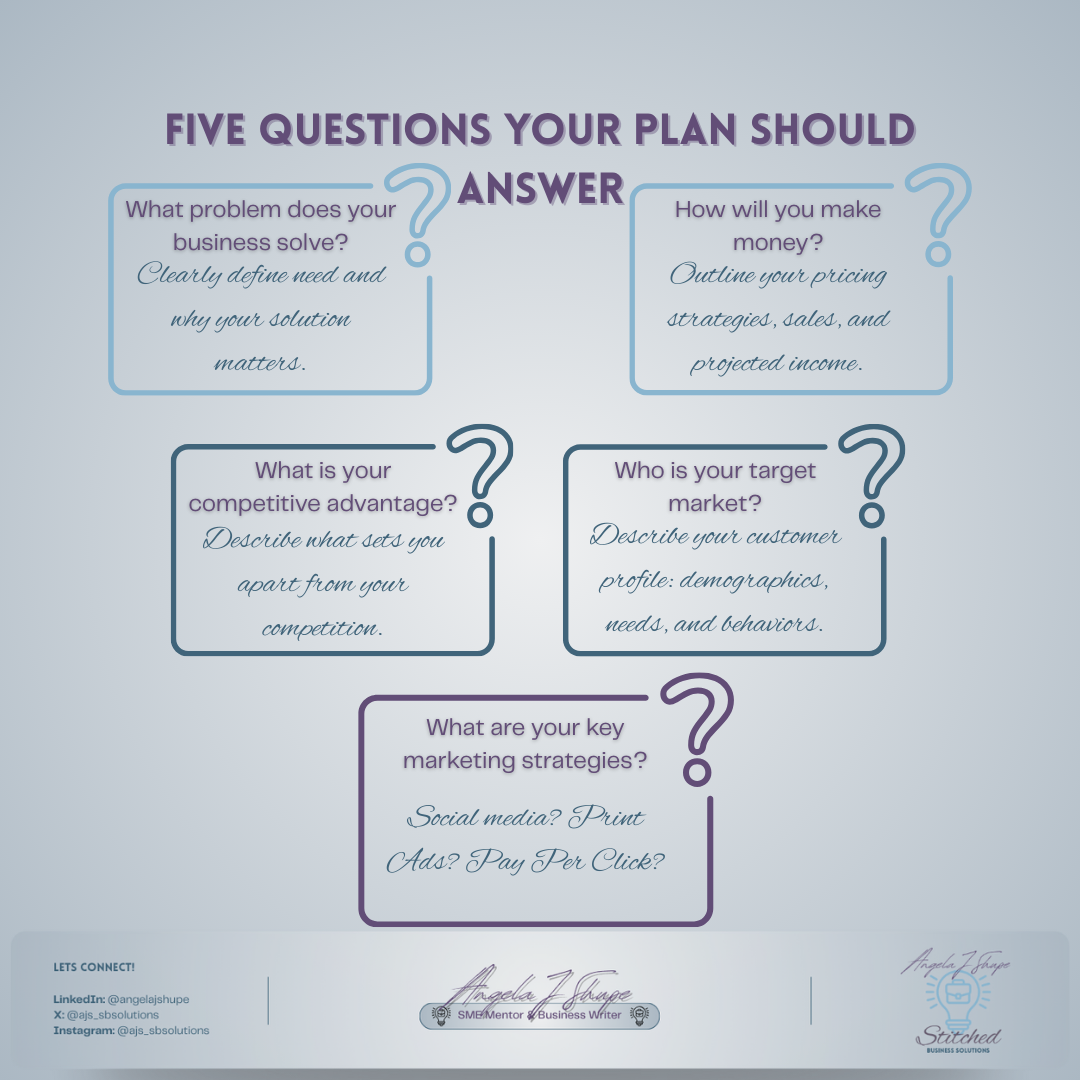
If done right, your one-page business plan should answer these 5 questions.
- What problem does your business solve?
- How will you make money?
- What is your competitive advantage?
- Who is your target market?
- What are your key marketing strategies?
If it does, you have the basis of what investors want to know before you proceed with a full presentation. Mentors also seek this information before they offer guidance.
These are the early questions they want answered.
You can walk tall knowing you’ve done your best, and your passion shines through your hard work.
Are you ready?
 Angela J Shupe—Stitched Business Solutions
Let’s Discuss